The Guests Beneath Abbey Green - A Phantoms & Fables Tale of Regency Bath
This is a subtitle for your new post
The Guests Beneath Abbey Green - A Phantoms & Fables Tale of Regency Bath
This is an imagined tale inspired by the strange reports of timeslips and the rich layers of history beneath the streets of Bath.
It brings together two very different periods in the city’s past, separated by centuries, yet occupying the same small corner of the city.
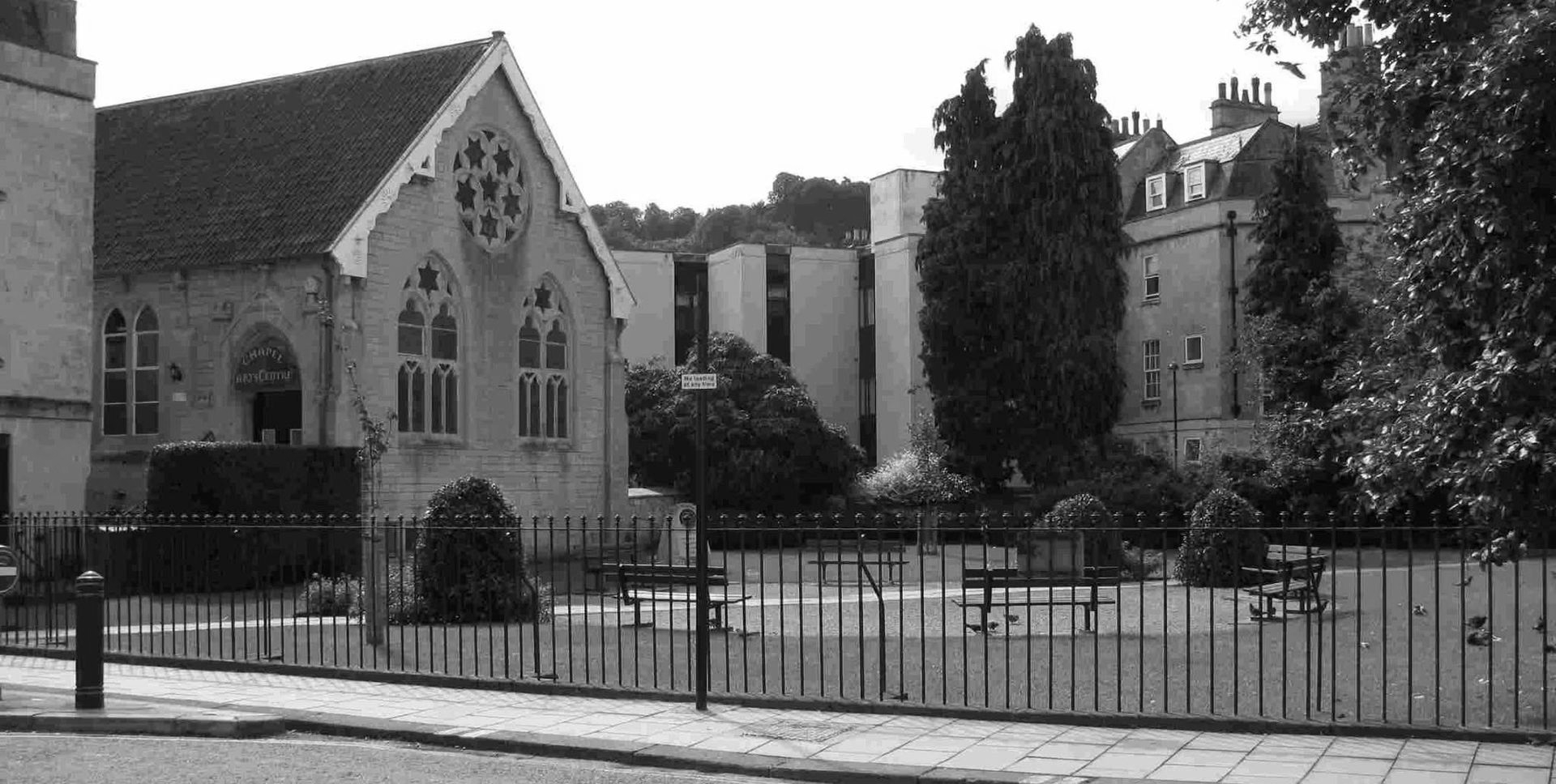
The Little Shop in Abbey Green
By the time the autumn evenings had begun to draw in, Phyllis was accustomed to working long after the shops around her had closed.
At fifty-five, she had long since lost any romantic notion of the dressmaking trade, it was hard work, made harder by the demands of fashionable Bath, where a lady might decide upon a new gown with scarcely a week’s notice and expect it to be ready for the next assembly.
Still, Phyllis had a reputation to maintain, and her little establishment in Abbey Green had served her well for many years.
It had belonged to her husband before his death, and when he passed away, the premises and the business had fallen to her.
She had never considered giving it up. She knew her customers, understood the fashions and possessed a skilled pair of hands.
What she did not possess was the comfort of a second income or a husband to share the burden of keeping the place afloat.
So she worked.
She was a dressmaker as well as a milliner, altering gowns, making evening dresses, trimming bonnets and creating the fashionable adornments that completed a lady’s appearance. There were always ribbons to wind, feathers to curl, hems to finish and accounts to settle.
This particular autumn, however, she had taken on a commission that promised to make the coming months rather more comfortable.
A prominent Bath hostess was preparing for a grand ball, and Phyllis had been entrusted with several important pieces of work.
There were gowns to alter, new trimmings to make and an elaborate headdress that was to accompany a particularly fine evening dress.
It was a considerable undertaking, but the payment would be welcome.
So, night after night, Phyllis remained at her worktable long after the last customer had departed.
It was during one of these late evenings that she first heard the voices, beneath the floorboards, the sound came from below.
Phyllis was in the back room, carefully stitching a length of silk, when she heard what sounded like two people talking in the cellar beneath the shop.
She paused, needle held between her fingers.
The cellar was an old, rather uncomfortable place, reached by a narrow staircase behind the workroom.
Its walls were of rough stone, the ceiling low and the air perpetually cool and damp. It was certainly no place for her valuable fabrics or delicate trimmings.
Instead, it served as a useful store for things that could withstand the conditions: spare candleholders, boxes of candles, old wooden hat stands, an assortment of tools and equipment, and a few pieces of furniture she had never quite found a reason to discard.
There was no reason to expect anyone to be down there.
At first, she thought it might be a neighbour.
The buildings in this part of Bath were old, and sounds travelled in curious ways through their walls and floors.
Then came a short burst of laughter.
Phyllis put down her sewing.
She listened for a moment, but there was nothing more.
She returned to her work, deciding that she had probably mistaken a sound from the street for something much closer.
A few evenings later, it happened again.
This time she heard footsteps, followed by the unmistakable clatter of what sounded like pottery being set down on a hard surface.
There was a low murmur of conversation, then a sound rather like water being poured from one vessel into another.
She went downstairs with a candle.
The cellar was as she had left it.
Her boxes stood in their usual places, a wooden hat stand leaned against the wall, and an old dressmaker’s dummy stood in the shadows beside a stack of furniture.
The stone walls glistened faintly with damp.
There was no one there.
Phyllis stood for a moment, listening, a drop of water fell somewhere in the darkness.
She shook her head, pulled her shawl more tightly around her shoulders and returned upstairs.
There was too much work to be done to concern herself with every little noise an old building might make.
As the weeks passed, the noises became familiar.
They were never quite the same, but there was a pattern to them. Sometimes she heard several voices, sometimes only one.
There were footsteps, the occasional scrape of something being moved and, now and then, the hollow clink of pottery.
On one occasion, she distinctly heard a woman laugh.
It was not the sound of someone calling for help, nor anything particularly frightening. Indeed, there was something strangely ordinary about it.
It sounded as though people were gathered somewhere below her, talking together at the end of an ordinary day.
Phyllis began to wonder whether there might be some passage or adjoining space beneath the premises, perhaps connected to an old neighbouring cellar.
She mentioned it to a tradesman who had come to repair a loose shutter.
He listened politely, then told her that old buildings often produced peculiar noises, particularly in damp weather. Pipes, settling stonework and the movement of water could all create sounds that were difficult to place.
It was a reasonable explanation, Phyllis accepted it, at least outwardly.
But one evening, while searching for a particular box of spare pins and sewing tools she kept among the old shop equipment, she heard something that gave her pause.
A man spoke.
The words were unfamiliar, and the language itself sounded unlike anything she had heard in Bath.
It was followed by a woman’s voice, then a light, quick movement of footsteps across what sounded like a stone floor.
Phyllis turned towards the far end of the cellar.
For a moment, she thought she saw the shadow of someone passing beyond the shelves.
She raised her candle, Nothing.
Only the uneven stonework and the dark recess behind an old wooden chest.
She returned upstairs rather more quickly than she had intended.
The winter brought more work, and Phyllis found herself spending an increasing amount of time in the cellar.
She occasionally needed to fetch candles, spare holders or some forgotten piece of equipment, and the narrow staircase became a familiar part of her daily routine.
She was no longer particularly alarmed by the sounds, they had become an oddity of the building, something she half expected to hear when the shop was quiet.
Yet there were moments when she could not quite dismiss them.
One evening, she was carrying a small box of candles downstairs when she heard a gentle splash, followed by the sound of someone setting down a vessel.
She stopped on the steps.
There was a smell in the air that she could not immediately identify.
It was faint, but different from the usual dampness of the cellar, something mineral, perhaps, with a hint of smoke.
At the bottom of the stairs, she caught sight of a movement near the far wall.
A figure.
It was there for no more than a moment: the outline of a person, perhaps a woman, moving across the space where she kept her boxes.
She blinked, and it was gone.
For several seconds she stood perfectly still.
Then, from somewhere beyond the wall, came a low murmur of voices.
She could not make out the words, but there was a distinct rhythm to the speech.
It was not English, it sounded old, unfamiliar and yet strangely natural, as though she had briefly overheard a conversation taking place in another room.
Phyllis retreated upstairs, she did not mention it to anyone.
There were still gowns to finish, and the great ball was approaching.
The Night of the Storm
The evening of the final fitting arrived beneath a heavy, oppressive sky.
All afternoon, the air had felt close and unsettled.
The clouds gathered over the city, darkening the windows long before dusk, and by nightfall a violent storm had begun to sweep across Bath.
Rain beat against the glass. Thunder rolled over the rooftops, sometimes distant and sometimes so close that the windows trembled in their frames.
Phyllis had intended to finish early, but one of the headdresses for the ball had proved more troublesome than expected.
A length of ribbon had to be replaced, and she had almost used the last of her candles in the workroom.
She needed to fetch another supply from the cellar.
Taking a candleholder with her, she descended the narrow staircase.
The storm was growing worse. She could hear the rain striking the ground above, and every so often a flash of lightning illuminated the cellar through the small, high window.
She found the box of candles beside the old chest and placed it on top.
Then she heard the voices.
Not the faint murmuring she had grown accustomed to over the past months, but several voices at once.
They seemed to be coming from all around her.
Phyllis turned.
There was the familiar stone wall, the shelves and the boxes. Yet the sound was so clear that she could almost believe there were people standing just beyond the room.
A man spoke, followed by a woman’s reply. There was a short laugh, the clatter of a vessel and the sound of footsteps.
Then came a tremendous crack of thunder.
The candle flame bent sharply, guttered and went out.
For an instant, Phyllis was plunged into darkness.
A flash of lightning illuminated the cellar.
But it was not her cellar.
The walls had changed.
Or rather, the room she stood in was no longer the room she knew.
the rough, familiar stonework seemed to have opened into a much larger space.
The ceiling was higher, the floor uneven beneath her feet, and the air was filled with the warmth of lamps and the smell of smoke, water and damp stone.
There were people everywhere.
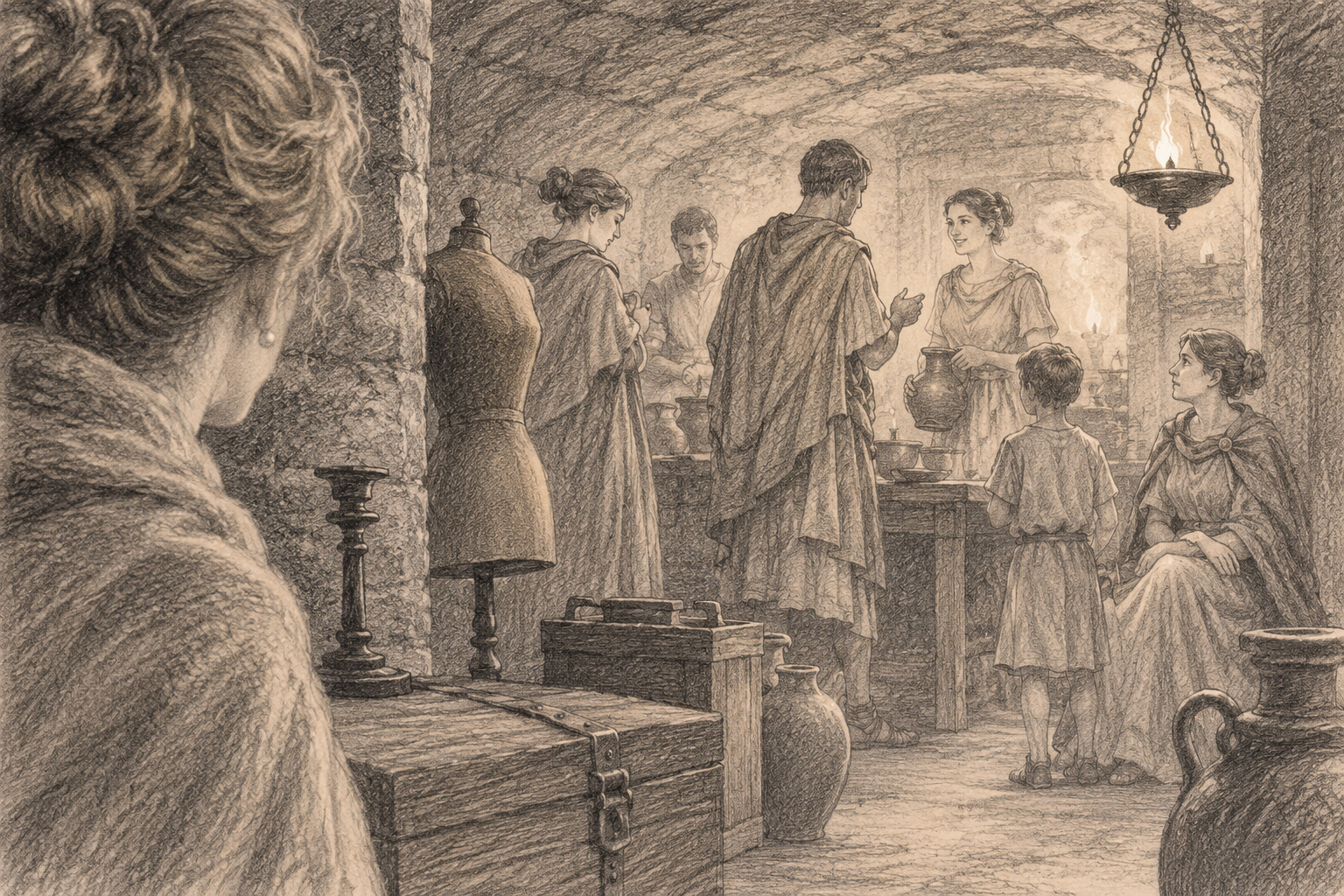
A man stood near a low table, speaking to a woman who was arranging several small vessels. Another woman, dressed in a long tunic, was seated nearby, adjusting the fastening of a cloak. A younger figure passed behind them carrying what appeared to be a bundle of clothing.
They were not pale or transparent, they were not shadowy figures or strange apparitions, they were simply people.
A woman laughed at something the man had said.
He answered her, gesturing towards the table. A child moved impatiently between the adults, and someone called to them in a language Phyllis could not understand.
The scene was so ordinary that, for a moment, she forgot to be afraid.
She watched as the woman lifted a small vessel and poured water into another. The man reached for a folded piece of cloth. Someone moved past Phyllis , close enough that she instinctively drew back.
But the person did not look at her.
No one did.
They carried on with their business, entirely unaware of the woman standing among them.
Phyllis looked towards the far side of the room.
There was an opening beyond which she could see more movement, the flicker of lamps and the suggestion of another space beyond.
She had the extraordinary sensation that she was looking into a world that had never ceased to exist.
Then she noticed the clothing.
The garments were unlike anything worn in Bath.
The women wore simple tunics and cloaks, their hair arranged differently, while the men were dressed in loose garments that fell to the knee. One carried a small leather bag, another held a vessel that caught the light.
Phyllis had never seen anything like it.
A fresh flash of lightning lit the room, and in that instant she understood, with a certainty that made her feel faint, what she was seeing.
Roman people.
Not a painting, nor a stage scene, nor some elaborate dream.
People who had lived in this very part of Bath, perhaps in this very place, many centuries before her own time.
She had heard of the Roman remains beneath the city, of the great baths and the temple, of the people who had travelled to Aquae Sulis seeking the healing waters.
But she had never imagined that she might see them.
The thunder came again, shaking the room.
The lamps flickered.
For a moment, the figures seemed to waver, as though the whole scene had become a reflection disturbed by rippling water.
Phyllis clutched the edge of the chest.
The woman with the vessel turned slightly, but her gaze passed through the space where Phyllis stood. She said something to the younger figure, who answered with a smile.
Then came another flash.
The room was gone.
The stone walls closed in around her.
The old chest stood in its usual place, the wooden hat stand leaned against the wall, and the dressmaker’s dummy loomed in the shadows.
Phyllis remained motionless.
Above her, the storm continued to rage.
She could still smell the faint trace of smoke and something mineral in the air, but the voices had vanished.
She picked up her candleholder and climbed the stairs.
The Morning After
By morning, the storm had passed.
Phyllis said nothing of what had happened, she had slept little, and in the cold light of day the events of the previous evening seemed almost impossible to put into words.
She returned to the cellar after breakfast.
Everything was as it should be.
The box of candles was still on the chest, her tools and spare equipment remained where she had left them. There was no sign of anyone having entered, nor any strange object or trace of the people she had seen.
The only thing that remained was the memory.
For several days she found herself listening for the sounds that had troubled her for so many months.
They did not return.
The commission was completed, the gowns delivered and the ball went ahead without incident. Phyllis received her payment and, for a time, enjoyed a little relief from the constant pressure of keeping her business afloat.
Life returned to its usual rhythm.
Yet she never quite forgot that night.
Occasionally, when the shop was quiet and she was working late, she thought she heard something beneath the floorboards. A footstep, perhaps. A faint murmur of conversation, or the distant clink of pottery.
But whenever she stopped to listen, there was nothing.
She never saw the people again.
Years later, when the old building had passed into other hands, the cellar was altered and its contents cleared away. No one who worked there afterwards mentioned anything unusual.
Perhaps the sounds had been nothing more than the ordinary noises of an old building.
Perhaps the storm, the darkness and the long hours had played tricks upon a tired woman’s mind.
Or perhaps, for one extraordinary moment, the centuries had drawn together, and Phyllis had looked through a small opening into the lives of those who had once visited the waters of Aquae Sulis.
They had not seen her.
They had not known she was there.
For them, it was simply another evening, in a place they knew well.
And Phyllis, in her own time, had been no more than a passing shadow beneath Abbey Green.
© P Wallace - Phantoms & Fables
Image - PJW Artworks
An original work of fiction, independently conceived and written for Phantoms & Fables of Bath.
Although inspired by the real streets and layered history of Bath, the characters and events are imagined.